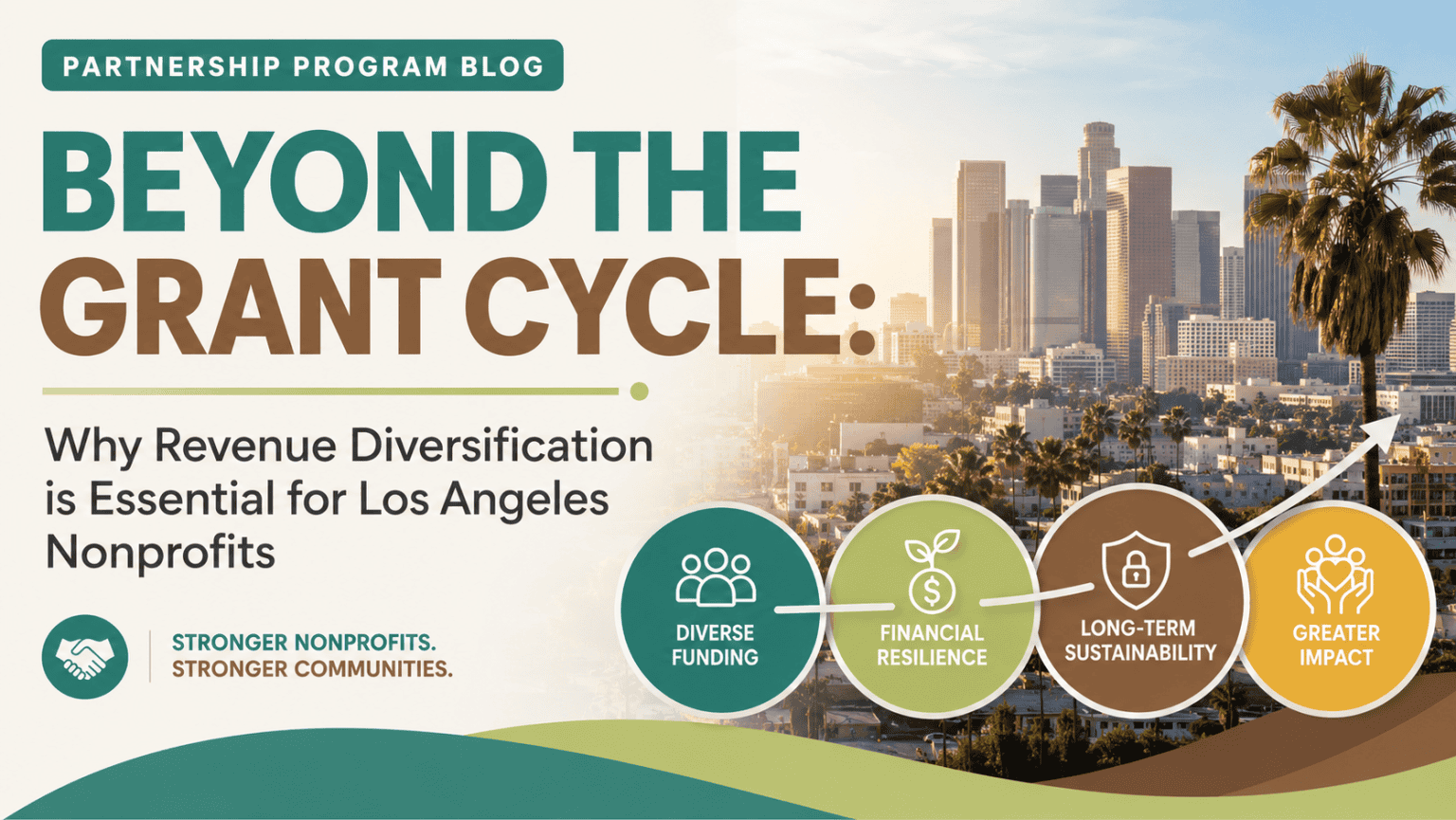
Beyond the Grant Cycle: Why Revenue Diversification is Essential for Los Angeles Nonprofits
For generations, community-based organizations across Los Angeles have relied on public and foundation grants as the primary foundation of their operational budgets. While grant funding plays a vital role in launching new initiatives and seeding specialized programs, heavy reliance on grants as a sole or dominant revenue source introduces structural vulnerabilities. In a high-cost, rapidly changing metropolitan area like Los Angeles, grant dependency leaves community organizations exposed to shifting philanthropic priorities, delayed public reimbursements, and restrictive allocation rules that underfund administrative overhead and frontline wages.
Building long-term operational resilience requires moving past single-stream funding strategies. By diversifying revenue engines to incorporate earned income, fee-for-service models, grassroots individual giving, and strategic asset monetization, Los Angeles nonprofits can protect their organizational autonomy while expanding community impact.
The Hard Reality of the LA Funding Landscape
Regional data compiled by the Nonprofit Finance Fund highlights the severe financial pressures confronting organizations operating across Los Angeles County. Comparative analyses reveal a significant structural gap between Los Angeles nonprofits and their national peers:
- Sustainability Hurdles: A striking 58% of Los Angeles-based nonprofits report that achieving long-term financial sustainability is a primary challenge, compared to 24% of nonprofits across the remainder of the United States.
- Unrestricted Revenue Shortages: Fifty-six percent of LA nonprofits report severe difficulty securing unrestricted revenue—capital essential for maintaining operating reserves, updating technology, and retaining staff—compared to 21% nationwide.
- Underfunded Full Costs: Fifty-five percent of LA organizations indicate that institutional grants fail to cover the full indirect and administrative costs of service delivery, compared to 26% nationally.
- Reimbursement Delays: Cash flow instability is further compounded by delayed contract disbursements. Only 40% of Los Angeles nonprofits receive contract payments on time, with 29% enduring reimbursement delays exceeding 60 days.
- Regional Philanthropic Disparities: According to CalNonprofits’ Causes Count Regional Profile, although the Los Angeles region houses 26% of California’s nonprofit organizations and 29% of the state’s population, its local philanthropic grantmaking footprint remains lower than other metropolitan hubs. For example, CalNonprofits state-level data shows foundations in Los Angeles distribute approximately $2.3 billion annually, compared to $6.2 billion granted by Bay Area foundations.
These financial constraints coincide with rising community demand. Nearly half (49%) of Los Angeles nonprofits report a significant increase (exceeding 10%) in demand for their services over recent fiscal cycles. Relying exclusively on competitive, short-term grant cycles to address growing safety-net demands creates ongoing budget instability.
Academic Insights: Resource Dependence and Mission Stability
Academic research grounded in Resource Dependence Theory (RDT) explains why high revenue concentration creates systemic organizational risk. When a nonprofit relies on one or two major institutional grantmakers for the bulk of its operational revenue, those funding sources exert substantial influence over organizational priorities and service delivery models.
Peer-reviewed literature highlights several key dynamics regarding funding structures:
- Mission Autonomy and Protection: Academic studies on NGO revenue diversification and mission changeability demonstrate that diversifying revenue streams mitigates funder concentration risk. This affords nonprofits greater independence to pursue community-defined priorities without risking mission drift to align with changing grant criteria.
- Output Creation: Empirical analyses published in Resource Dependence Theory research demonstrate a positive relationship between revenue diversification and organizational output creation, challenging the assumption that pursuing non-grant revenue streams distracts from core mission execution.
- Mitigating Concentration Risk: Nonprofit organizations carry heavy concentration risk by relying heavily on one or two primary revenue channels. When an institutional funder pivots geographic focus or a government contract sunsets, organizations without alternative revenue sources face abrupt service cuts or closures.
Key Pillars of Revenue Diversification for LA Nonprofits
It’s not just about fundraising folks, to achieve financial self-determination, Los Angeles nonprofits can build self-sustaining revenue mechanisms that complement traditional grantmaking. Statewide data indicates that California’s nonprofit sector as a whole generates significant revenue through program fees and earned income initiatives. Local organizations can evaluate several practical diversification pathways:
| Revenue Model | Practical Application | Strategic Benefit |
| Fee-for-Service & Earned Income | Implementing sliding-scale fees for direct services, professional development, or corporate wellness programs. | Generates predictable, unrestricted cash flow directly tied to service delivery. |
| Consulting & Technical Assistance | Monetizing specialized domain expertise by advising municipal agencies, corporate social responsibility initiatives, or peer entities. | Translates existing organizational knowledge into sustainable earned revenue. |
| Facility & Asset Sharing | Leasing underutilized office space, event venues, or specialized equipment to commercial partners or community groups. | Converts static physical assets into passive income streams. |
| IP & Curriculum Licensing | Licensing proprietary training modules, educational toolkits, or evidence-based program models to external institutions. | Produces scalable recurring income with minimal incremental overhead costs. |
| Individual Micro-Donation Pipelines | Building community-supported giving programs and recurring monthly subscription options. | Broadens funding support beyond institutional gatekeepers while deepening local community involvement. |
Actionable Steps for Organizational Leaders
Transitioning from grant dependence to a multi-stream financial model requires deliberate strategic planning and governing board engagement. This isn’t just a one-meeting type of decision, it’s a slow, methodical one.
- Perform a Revenue Concentration Audit: Assess current funding structures to identify single-source dependencies. If a single grant or foundation source comprises more than 25% of total operating revenue, establish immediate diversification goals.
- Establish Operating Cash Reserves: Direct net revenue from earned income activities into unrestricted operating reserves to insulate the organization against delayed public contract reimbursements.
- Invest in Business Development Capabilities: Earned income strategies require market research, financial planning, and business development skills. Executive teams should allocate resources toward building enterprise skills alongside traditional grant writing capacity.
- Pursue Full-Cost Grantmaking: While expanding earned income, continue advocating for foundation grants that explicitly cover administrative indirect rates and equitable employee compensation.
A Note to Leaders:
Sometimes, reading articles like this can be anxiety-inducing. I am not telling you that you are doing something wrong, simply that we all tend to fall into this trap because the system was not designed for nonprofits to flourish. Whether you are setting aside $5 or $500 into operating reserves or are simply starting the research process for earned income as long as it’s on your radar, then you are succeeding in considering revenue sustainability and diversification.